

Pet Trick Phase 2 – IPC
This phase was started with full steam on getting row-column scanning from paper to a reality, followed by creating the actual device people would interact with.
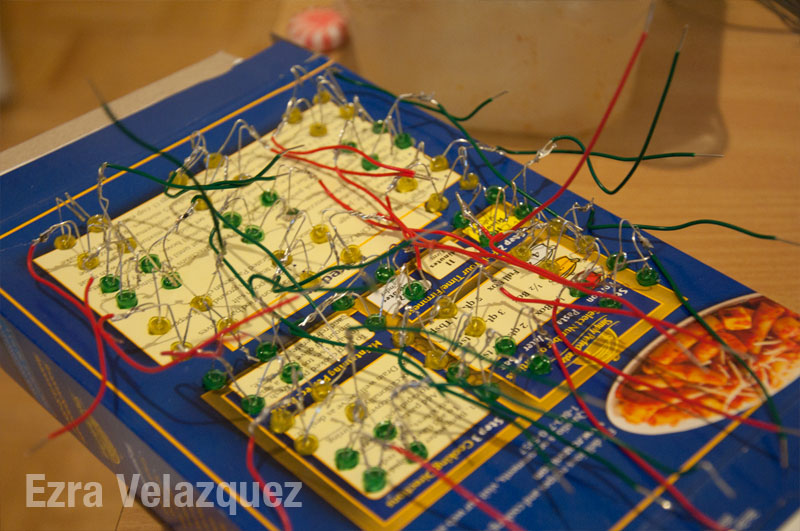
The LED’s where laid out in a 6×3 row-column scanning, which allows me to connect more rows (anode) into the shift register (595 chip), and save me 3 Arduino inputs. At first I was having issues with the brightness of the LEDd’s, it worked great if you where planning on playing Tic-Tac-Toe in a complete dark room. Did some reading, some asking, and found out that I needed to use transistors. It feels exciting using all this other hardware which I have never used before, and relying that it will do its part to make the whole system work.
Something else I did learn during the construction of the LED board was that you should always use your meter to measure how much voltage and amps wall connecters actually give. To make a long story short, I ended up frying the heart & soul of the Arduino chip. It was either I was giving the Arduino too much ‘juice’ or I probably went from ‘Vin’ pin to the ‘power’ in instead of ground, and caused the dreaded short circuit.
Like in other aspects in life, practice makes perfect, and DIY electronics is no exception.
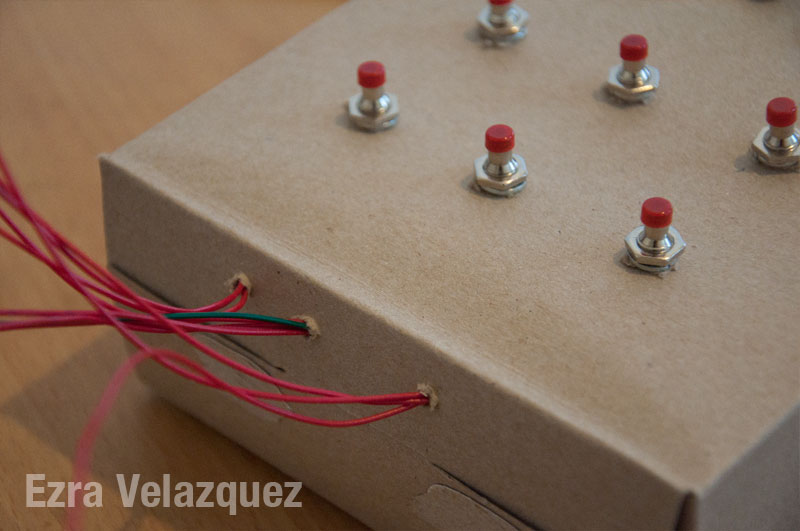
I was also able to work on the user interface, the 10 button board. Nine buttons are arranged to represent the tic-tac-board, while the flipper switch is for players to mark if it’s either Player’s Zero or Player’s One turn (computer science reference). The wiring seemed simple for this board, since all the buttons are input, they all share a common power via parallel connection, and each are grounded individually to the Arduino as input. Originally they where all going to share a common ground and be individually powered (hence the color of the wiring), but looking at earlier tutorials it always has ground going to the Arudino as input.
Cardboard boxes where decided to be used due to the fact that I eat a great deal of pasta, and I wanted to reuse the boxes in some form. I also felt it would be nice working with cardboard for my big project, and as I continue with other projects I would eventually get to work with different types of wood, plastics, and metals.





Related Posts


Leave a Reply