

Fantasy Device
Too Drunk to Spunk
Driving under the influence is a problem that continues to plague metropolitan and rural areas. The driver is endangering his or her life along with anyone in the car and other fellow drivers. Police officers and state troopers continue the battle against driving under the influence by conducting road stops and check points. Their efforts are great, but being humans, there will be times when drivers under the influenced are not stopped or noticed.
By using the “Too Drunk to Spunk”, any driver, who uses the device, will not be allowed to drive if intoxicated. By not allowing them to drive, the device will lower the number of people driving under the influence, which in return will lower the amount of vehicle accidents, deaths, and DUIs given. The police and state troopers should not be the only ones making sure the roadways are safe; drivers must do their part.
The device itself is a small rectangular box, which is a little bigger than a vehicle key. The vehicle key itself is connected to the inside swivel of the device. The key will move in and out of the device like a knife in a swiss army knife. On the exterior if the device, there will be a key-chain hook and a logo/sensor. The key-chain hook will allow the device to be attached to the driver’s key-chain, so it becomes part of daily life. The logo/sensor will be on one of the bigger sides of the device.
Diagram:
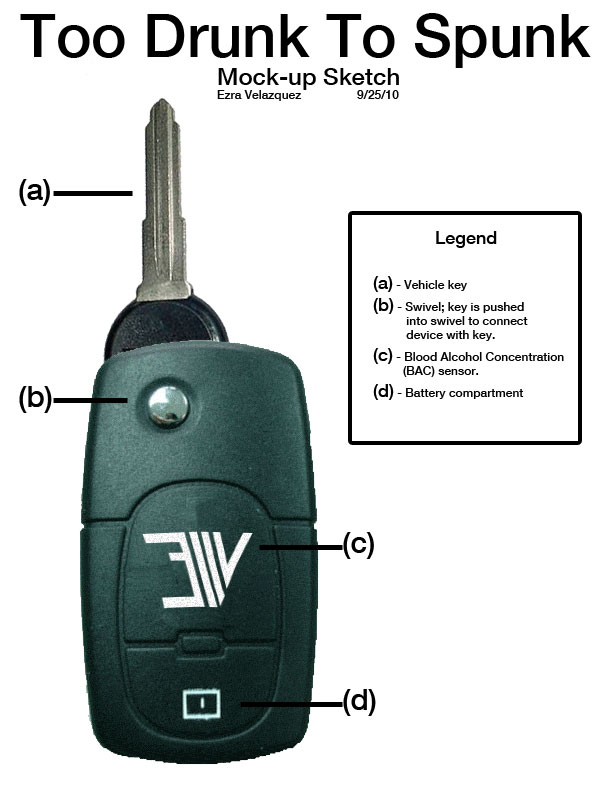
Procedure:
In order to have the vehicle key swivel out, the driver must press with his or her thumb the logo/sensor. A series of commands, which are outlined below, are executed by the device in order to determine if the key should swivel out:
a) Is the sensor pressed?
a.a) No, do not swivel out the key. Go back to (a).
a.b) Yes, the sensor was pressed. Go to (b).
b) The sensor takes a physical reading of the body alcohol concentration (BAC) via the driver’s thumb. Go to (c).
c) Is the BAC within legal limits? (A non-drinking driver will have traces of alcohol in their body, up to 0.009 BAC)
c.a) No, do not swivel out the key. Go back to (a).
c.b) Yes, go to (d).
d) Deactivate lock to swivel out key. Go to (e).
e) Is key swiveled back into device?
e.a) No, do not accept input from sensor. Go to (e)
e.b) Yes, the key was swiveled back into the device. Go to (a)
Benefits:
- Drivers under the influence will not be allowed to start his or her car.
- Lower number of intoxicated drivers on the roadways.
- Friends will feel secure knowing that their intoxicated friend will not be able to drive away.
- Make police and state troopers’ job much easier.
Assumptions:
- Driver and/or state must willingly install device on vehicle keys.
- Driver intoxicated will not ask other friends to activate their key.
- Battery will expire at appropriate times.
Risks/Issues:
- If battery dies, vehicle key will not swivel out until new battery is added.
- Intoxicated driver will be locked out of his or her vehicle. This could be an issue if driver is in questionable surroundings.
This process was based off the blog entry “How to Write an Effective Design Document“

One Comment
Nice to see you thought of the possible issues… I think the battery one could be really tricky.
I wonder if there is a way to do this without technology? Like a really hard puzzle has to be undone or the key doesn’t come out, or some sort of balance challenge.
Tom Gerhardt
9/26/2010
Leave a Reply